
Search South Carolina Felony Records
South Carolina felony records are public documents maintained by the General Sessions Court in each of the state's 46 counties and by the South Carolina Law Enforcement Division. Each county clerk holds complete criminal case files for felony charges filed in that jurisdiction. The state's SLED CATCH system provides statewide criminal history searches online. You can search these records through the Public Index, by mail, or in person at courthouses across South Carolina.
South Carolina Felony Records Quick Facts
Where to Find South Carolina Felony Records
South Carolina has two primary sources for felony records. The South Carolina Law Enforcement Division serves as the central state repository for all criminal history information. SLED maintains records of arrests, charges, and dispositions submitted by law enforcement agencies and courts from all 46 counties. Their headquarters is at 4400 Broad River Road, Columbia, SC 29210. The Records Department can be reached directly at 803-896-1443. SLED provides access to criminal history through both the online CATCH system and mail-in requests with no convenience fee.
The South Carolina Law Enforcement Division is the official state-level source for criminal background information. Their records cover convictions, pending charges, and other criminal history for cases processed in South Carolina courts. Fingerprint-based searches are the most accurate method and reduce the chance of a false match. Name-based searches through CATCH may return false positives when multiple people share similar names and dates of birth. Mail requests to SLED are accepted with payments by business check, certified check, cashier's check, or money order. Personal checks and cash are not accepted.
SLED is the starting point for anyone doing a thorough criminal history check in South Carolina. The agency maintains records going back many years across all jurisdictions in the state.
The second major source is the General Sessions Court in each county. This court handles all felony criminal cases in South Carolina. The Clerk of Court in every county keeps the full case file for each felony charge filed there. These files include indictments, warrants, bonds, plea agreements, sentence sheets, and court orders. You can access these records at the Clerk of Court in the county where the case was heard. The South Carolina Judicial Branch provides contact details for all 46 county court offices.
Note: SLED CATCH searches South Carolina records only. Cases from other states require separate searches through those states' agencies.How to Search Felony Records in South Carolina
The fastest way to search criminal history in South Carolina is through the SLED CATCH portal. CATCH stands for Citizens Access to Criminal Histories. This online system allows anyone to search South Carolina criminal records using a name and date of birth. The fee is $25.00 per search with an additional $1.00 convenience fee for online requests. Most major credit and debit cards are accepted. Results are available immediately after payment and can be viewed and printed from any internet-connected device.
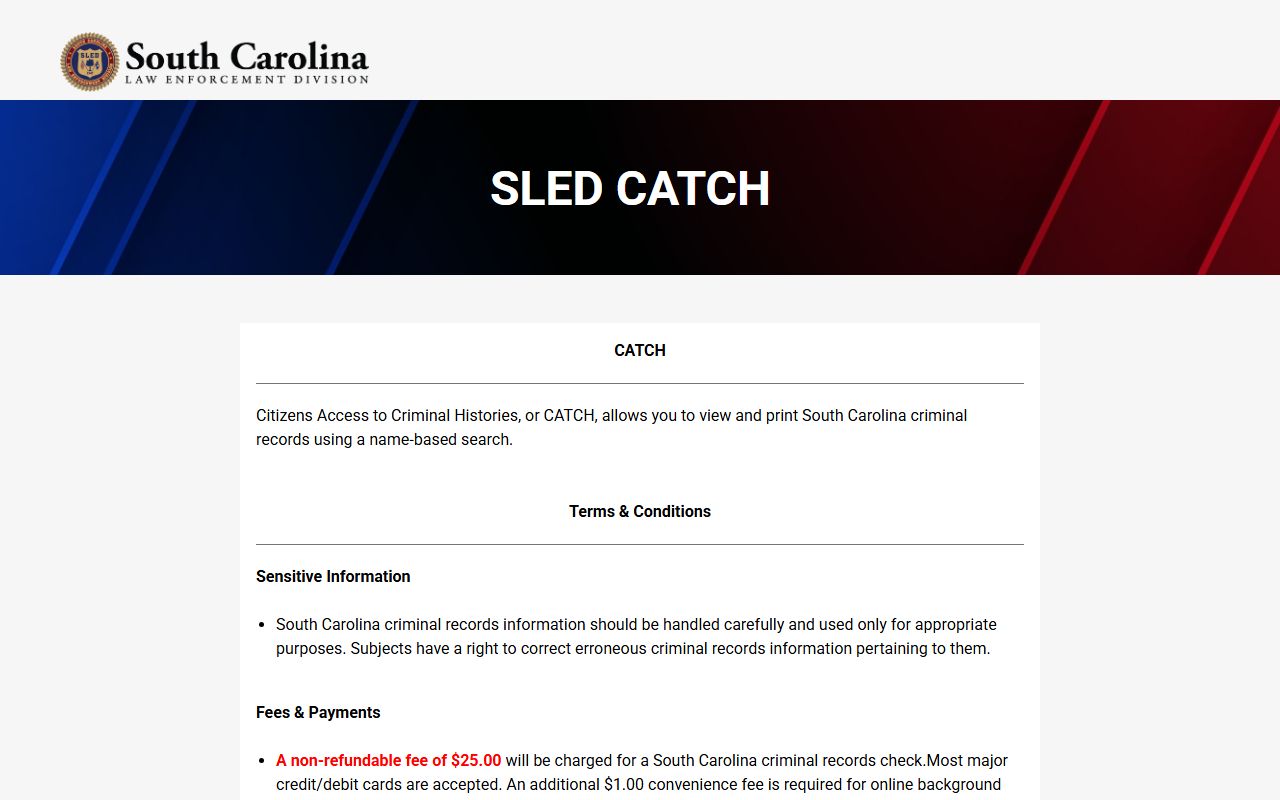
CATCH is a name-based search only. It requires a match on the subject's last name, first name, and date of birth. When a search returns multiple matching subjects, the system displays a "Special Processing Required" message and additional steps are needed. Information on wanted persons is not included in a CATCH report. The system also does not search the sex offender registry, which requires a separate search at scor.sled.sc.gov.
The South Carolina Judicial Branch Public Index is a free option for searching court case records. This system covers all 46 counties and lets you look up felony cases by name or case number. It shows filing dates, charges, hearing schedules, and case status. Certified copies of documents require contacting the county Clerk of Court directly. Begin a free search at sccourts.org.
To search felony records in South Carolina, you generally need the full name of the person you are searching, a date of birth for SLED CATCH, the county where the case was filed for in-person searches, and a case number if you have one. In-person searches at any Clerk of Court are free to view. Staff can provide copies for a per-page fee. As of January 1, 2026, home address information is no longer shown on the public index for privacy protection.
South Carolina Felony Classifications Explained
South Carolina classifies felonies into six categories under Title 16 of the SC Code of Laws. Each class carries a different maximum prison sentence. The class assigned to a crime determines the range of punishment a convicted person can receive. Section 16-1-90 of the Code lists all crimes by their felony class. Understanding these classes helps when reading criminal case records or researching felony charges in South Carolina.
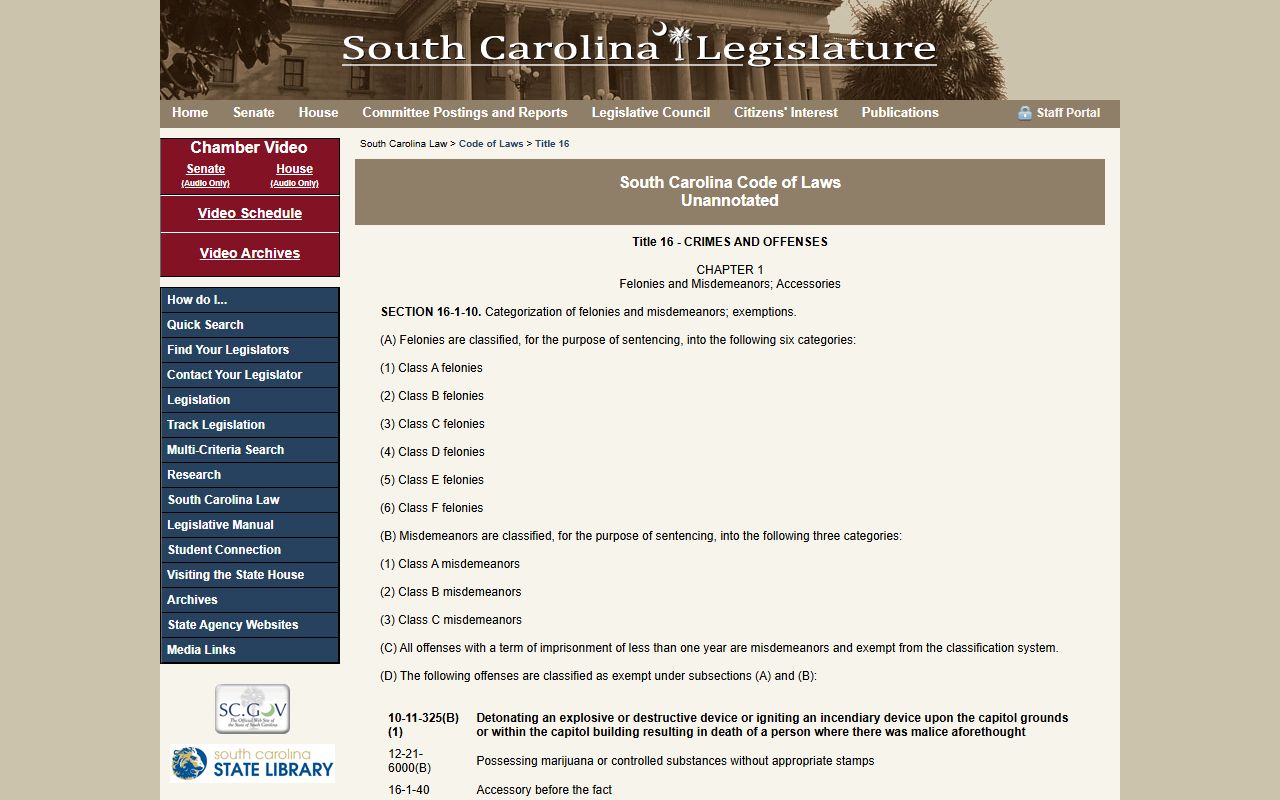
Class A felonies carry the most severe penalties. These include murder, kidnapping, criminal sexual conduct in the first degree, and armed robbery. A Class A conviction can result in up to 30 years in prison. Class B felonies such as voluntary manslaughter, attempted murder, and carjacking with great bodily injury carry up to 25 years. Class C felonies allow up to 20 years, while Class D offenses carry up to 15 years. Class E felonies have a maximum of 10 years, and Class F felonies carry up to 5 years. Anyone who aids or abets in the commission of a crime can face the same penalties as the principal offender under Section 16-1-20.
Note: South Carolina felony classifications set the maximum sentence range. Judges have discretion within those limits unless a mandatory minimum applies.SC Department of Corrections Inmate Records
The South Carolina Department of Corrections maintains records for all people currently incarcerated in state prisons and correctional facilities. The online inmate search lets you look up a person by their SCDC number, SID (State Identification) number, or name. Search results show the inmate's current location, offense history, sentence details, and projected release date. The database is updated daily to reflect new admissions, transfers, and releases.
SCDC facilities house people sentenced to more than 90 days. Shorter sentences are typically served in county detention centers. Released inmates are removed from the active search. For mail requests, write to: SCDC, Director's Office, PO Box 21787, Columbia, SC 29221-1787.
South Carolina Sex Offender Registry
The South Carolina Sex Offender Registry is maintained by SLED under S.C. Code Ann. § 23-3-400. The registry is searchable by name, city, county, or zip code. It provides information on registered sex offenders across the state, including each offender's name, photograph, physical description, last reported address, conviction information, and known aliases. County sheriffs in all 46 counties handle local registration and verification.
Following the 2022 amendments under Act 221, South Carolina operates a three-tier registry system. Tier I offenders may request removal after 15 years. Tier II offenders may request removal after 25 years. Tier III offenders must petition the General Sessions court after 30 years with no administrative removal option. All offenders must register every six months for life unless removal is granted. The registry is free to search and separate from a SLED CATCH criminal history search.
Note: The sex offender registry does not appear in CATCH results. Search scor.sled.sc.gov separately to check sex offender registration status.Felony Records Access Under South Carolina Law
South Carolina adopted the Freedom of Information Act in 1987 under Title 30, Chapter 4 of the SC Code. This law gives any person the right to inspect, copy, or receive electronic transmission of public records held by state and county agencies. Felony case records held by county clerks of court are public records under this law. You do not have to be a party to a case to access these records in South Carolina.
When you submit a FOIA request, the agency has 10 business days to respond for records less than 24 months old. For records older than 24 months, the response window extends to 20 business days. The agency must produce requested records within 30 calendar days from initial response. Copy fees cannot exceed the prevailing commercial rate. Search and retrieval fees are limited to the prorated hourly salary of the lowest-paid employee able to fulfill the request. Criminal conviction records are generally subject to full disclosure. Under Section 17-1-40, certain records must be destroyed when charges are dismissed or a person is found not guilty. Expunged records are exempt from FOIA disclosure.
Federal Criminal Records in South Carolina
Federal felony cases in South Carolina are handled by the U.S. District Court for the District of South Carolina. South Carolina was consolidated into one federal district in 1965 with statewide jurisdiction. The court maintains staffed offices in Charleston, Columbia, Florence, and Greenville. These offices are open Monday through Friday from 9:00 a.m. to 4:30 p.m. for party index research. All records in the Clerk's Office are filed and retrieved by case number.
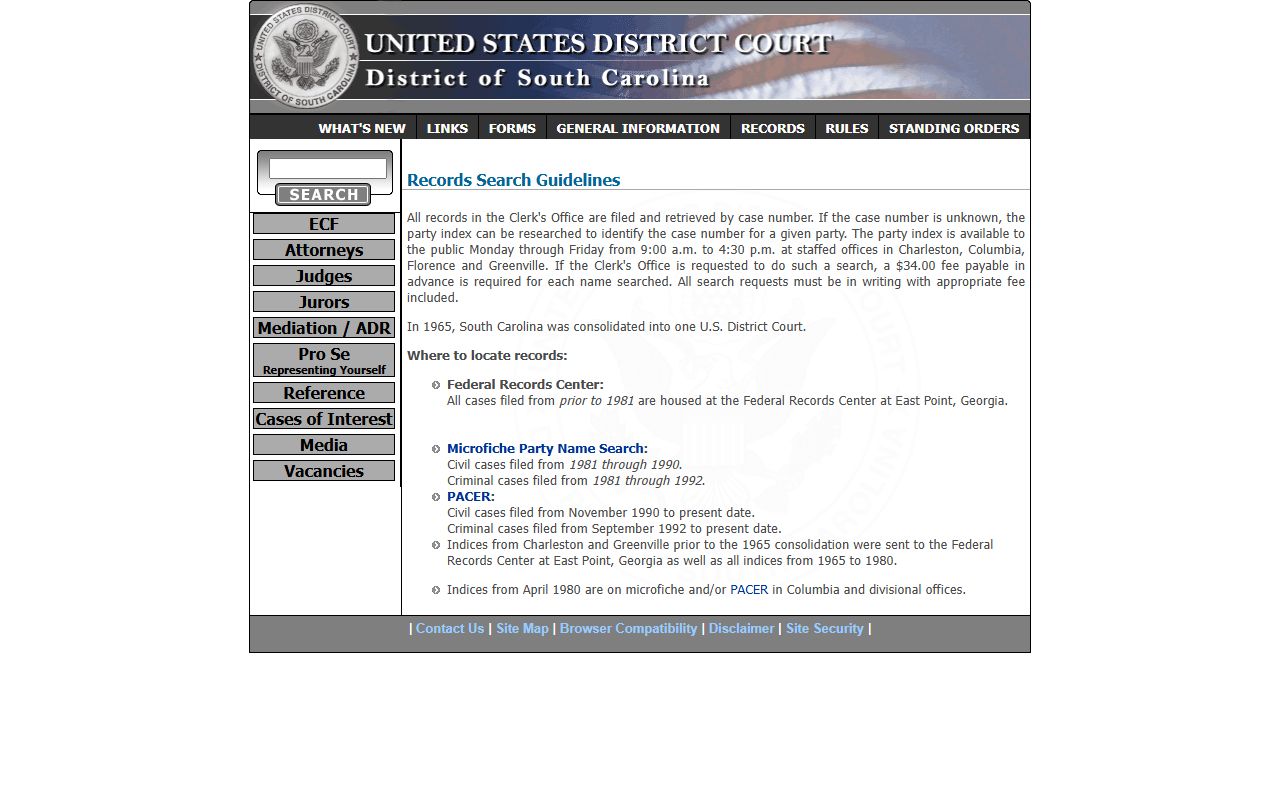
Name search requests submitted in writing require a $34.00 fee paid in advance. PACER (Public Access to Court Electronic Records) is available online for criminal cases filed from September 1992 to present. Cases filed before 1981 are housed at the Federal Records Center in East Point, Georgia.
South Carolina Appellate Court Records
The SC Appellate Court C-Track Public Index provides access to case information filed with the South Carolina Supreme Court and Court of Appeals. This is a free public service allowing anyone to view events, documents, and basic case information for appellate cases. Records are available from May 1, 2012 to present. Cases, events, and documents that are sealed or confidential are not available online.
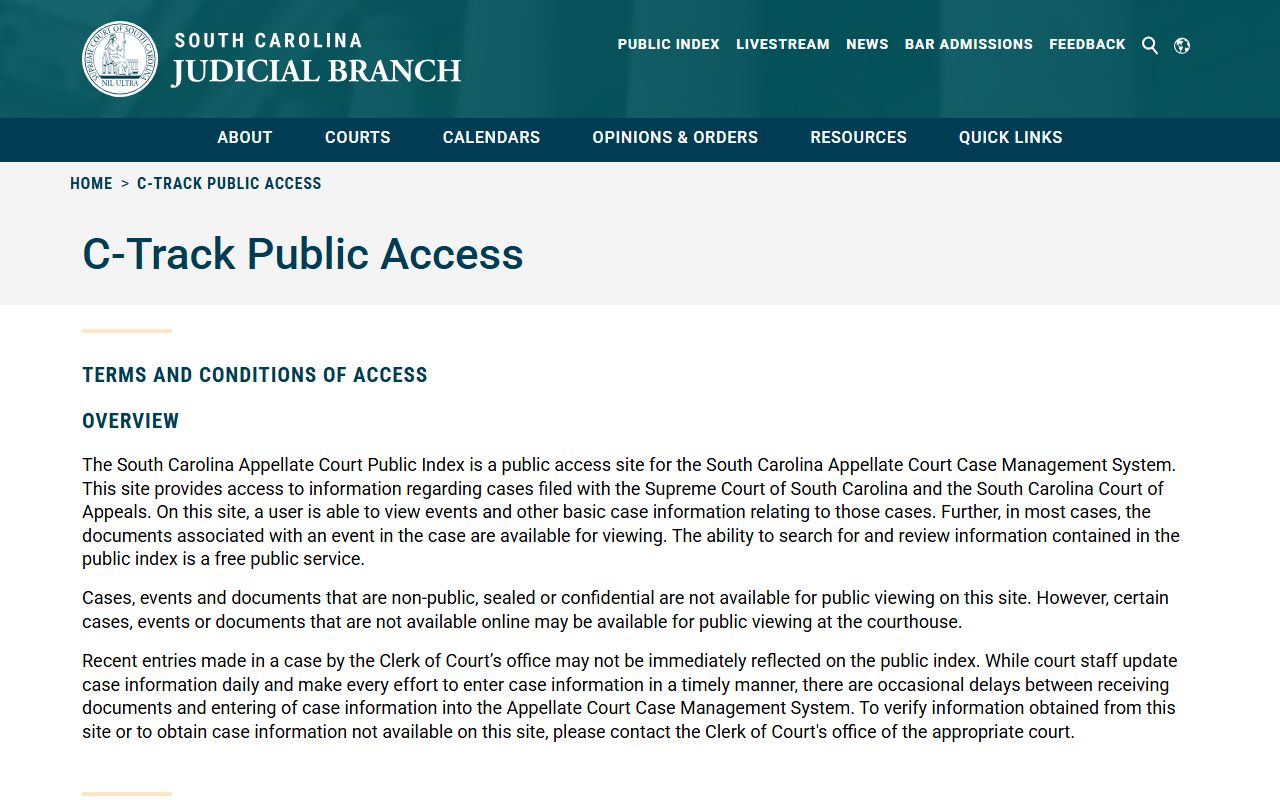
Court staff update case information daily. Recent entries may not appear immediately. Felony convictions appealed to the Court of Appeals or Supreme Court will have records in this system for cases after May 2012. Some materials not available online may be accessed at the courthouse in person.
South Carolina Court Forms and Expungement
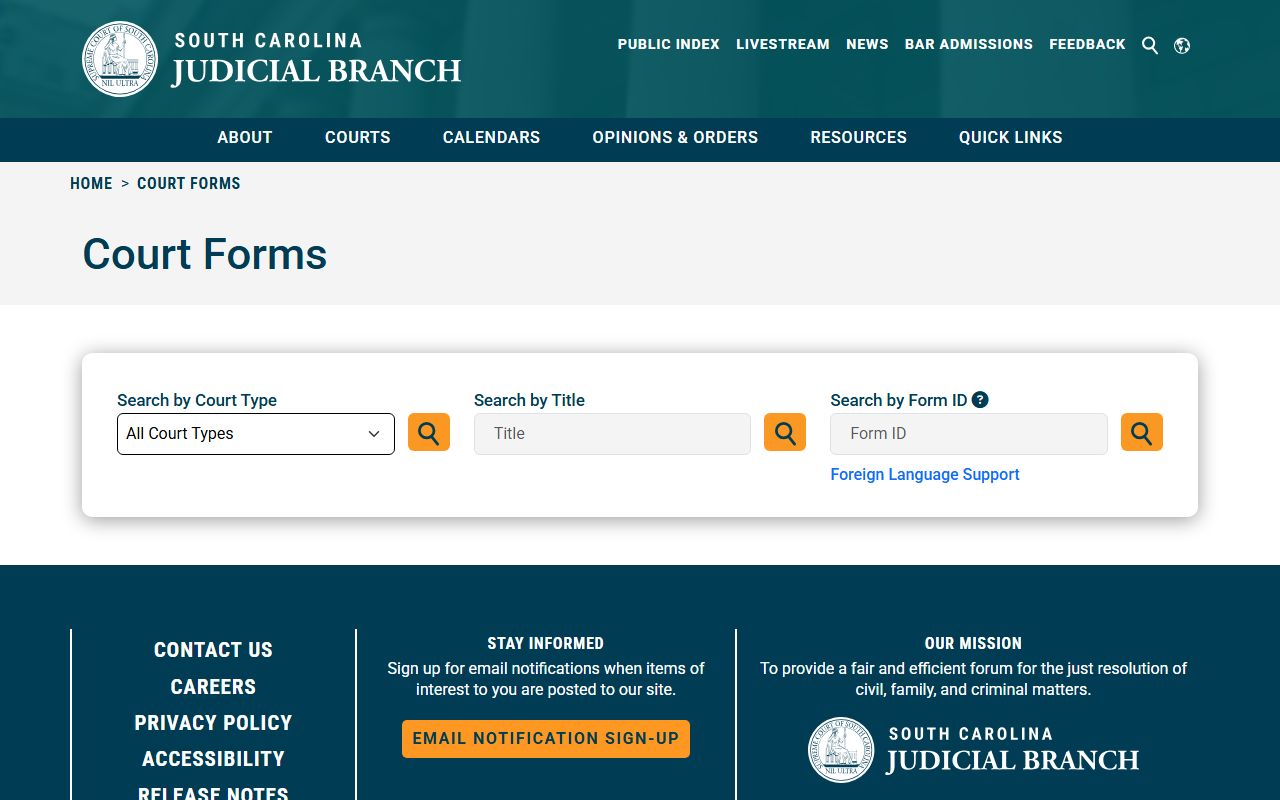
The South Carolina Judicial Branch forms portal provides standardized court forms for all case types including criminal matters. Forms are searchable by court type, title, or form ID number. Criminal forms available include arrest warrants, bench warrants, bond forms, subpoenas, and expungement forms. Most forms are available as PDF downloads. Some can be completed online before printing. Spanish language versions exist for commonly used forms.
Expungement in South Carolina can remove certain criminal records from public access. Section 22-5-910 of the SC Code provides for expungement of certain first offense convictions after five years. Section 17-22-910 establishes procedures for expungement of various other criminal records. Once a record is expunged, it is not available through SLED CATCH or the Public Index. To begin an expungement, you file a petition with the Solicitor's Office in the circuit where the case was heard. Fees vary by county.
Note: Not all felony convictions qualify for expungement in South Carolina. Contact the Solicitor's Office in your circuit to determine eligibility.Browse South Carolina Felony Records by County
Each county in South Carolina has its own General Sessions Court that keeps felony records. Pick a county below to find local contact information and resources for criminal case records in that area.
Felony Records in Major South Carolina Cities
Residents of South Carolina cities have their criminal cases handled at the county courthouse. Pick a city below to find felony record resources and court information for that area.